Latest News
- Wuxi's Nanchang Street--a historic cultural district that combines classical charm, delicious food, and fun activities
- chinese study
- lastest courses
- Business Assistance/International Consortium of Stem Cell Research
- Foreigner's view of Jiangsu -Changzhou Jintan starts
- estimonials for Our new French Internship student Anais 企业表扬信
- The Double Seventh Festival in China Introduction
- Chinese Proficiency Test (HSK)
- China University Mining and Technology
- Wuxi Library
Students Say

Mandarin Student Zack
Mandarin Education School is a great place to learn Chinese and Chinese Culture.I've learned a lot in this school, my Chine...

Learn Chinese Travel China
If you want to learn Chinese and also discover China, Mandarin Education organize the most funny and cultural study tour.
The...
suzhou Mandarin Jude
I am Jude, I am learning Mandarin in Suzhou Mandarin School,I was learning in Wuxi Mandarin Education too.I like my Chinse Teacher...
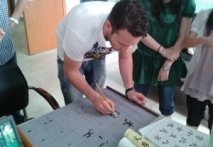
chinese class
Improve your reading, speaking and your writing by experiencing our teaching methods,Offer free student Visa.
...

Wuxi Mandarin Jessie
I've learned Chinese for almost 8 years, I can understand what Chinese people say,but when I speak, I feel very uncomfor...

Chinese Internship or Jobs
You are looking for a professional experience abroad? Get the opportunity to discover the Chinese business,Look for an ...

Mandarinedu Student Florent
I love my Wuxi Mandarin Education School. It is the EASY MANDARIN Learning way, I am learning faster than I wanted.My teach...

Mandarin E Learning
Mandarin Education School offers you Online Chinese Courses. It has never been so easier to have Chinese courses ...

Mandarin Student Brad
I am studying Chinese in Mandarin Education School. I can speak quit good Chinese and talk to Chinese people by myself. Thank...
Wuxi Mandarin edu. Student Jennifer
I love learning Chinese in Mandarin Education School.That's a great place to learn and make friends.
...
Add Our School Official
to get more informations

0086 1866 1199 988
0086 510-81151808
Sandy.Swun
519988808
Mandarin Education School
Room 405, 4 Fl,Building No.8,
Maoye Business Center,
Chang jiang No.1,
New district , Wuxi City , China
- Written: YCT Levels 1, 2, 3 and 4;
- Speaking: YCT Elementary and YCT Intermediate, recorded and scored centrally.
- A reference for candidates to understand and improve their own Chinese ability;
- A reference for schools delivering Chinese teaching;
- A reference for teaching institutions and training providers evaluating their own effectiveness;
- A reference point for candidates moving on to HSK.
- Assess before registering. Use the vocabulary benchmarks for a rough check and choose a level that is a genuine stretch but reachable. Passing it should feel like an achievement.
- Frequency beats intensity. For young learners, steady input matters most. A fixed weekly slot plus light contact between lessons outperforms a month of cramming.
- Keep results and process separate. The score report is a snapshot for planning the next stage, not something to attach to rewards or penalties.
Parents ask this constantly: my child has studied Chinese for two years — should they sit an exam? To answer it, it helps to know what YCT was actually designed to do.
How YCT is structured
The Youth Chinese Test (YCT) is a standardised international exam measuring the ability of primary and secondary school students who are not native Chinese speakers to use the language in daily life and study. It consists of two independent parts:
Vocabulary benchmarks
The published level correspondence gives approximate vocabulary sizes and a reference alignment with HSK and the Common European Framework of Reference (CEFR):
| Level | Vocabulary | Reference alignment |
|---|---|---|
| YCT Level 1 | 80 | Entry |
| YCT Level 2 | 150 | Same band as HSK 1, CEFR A1 reference |
| YCT Level 3 | 300 | Same band as HSK 2, CEFR A2 reference |
| YCT Level 4 | 600 | Same band as HSK 3, CEFR B1 reference |
What the exam is officially for
YCT was built on a principle described as linking testing with teaching, aiming to build learners confidence and sense of achievement — testing that supports teaching and supports learning. Four uses are listed officially:
Three common mistakes
Mistake one: treating the exam as the goal. The uses above make it clear that YCT is a reference point, not an admissions threshold. Treated as a finish line, it tends to produce a "stop right after the test" pattern.
Mistake two: skipping levels. Vocabulary grows in steps from 80 to 600 words. Skipping a rung leaves holes in listening and speaking, so a child may pass the written paper while real communication lags behind.
Mistake three: only practising the written paper. A separate speaking test exists precisely because speaking needs its own training — and for children growing up outside a Chinese-speaking environment, speaking is the skill that decays fastest.
Three suggestions for parents
Mandarin Edu sequences its young learner programme along the YCT progression, with listening and speaking first and literacy following. After each stage assessment parents receive a concrete progress note. If you would like to know which level your child should start at, arrange a free trial lesson and assessment with us.
Ready to plan your Chinese learning?
Mandarin Edu runs centres in Wuxi, Changzhou and Suzhou, offering HSK preparation, Business Chinese, corporate training and short-term study programmes. First consultation is free.
